
























What size is an ID card? CR80, CR79, CR90, and CR100 dimensions
The standard ID card is a CR80: 3.375 x 2.125 inches (85.6 x 54 mm), the same rectangle as a credit card, normally 30 mil (0.76 mm) thick. The dimensions come from the ISO/IEC 7810 ID-1 standard, which is why a CR80 card fits off-the-shelf holders, lanyards, slot punches, and swipe or tap readers. The other "CR" sizes exist for adhesive-backed cards and oversized visitor or security credentials.
What is a CR80 card?
A CR80 card is the standard plastic card size used for ID badges, access credentials, credit cards, and gift cards: 3.375 x 2.125 inches (85.6 x 54 mm) with 1/8 inch (3.18 mm) rounded corners, most often produced at 30 mil (0.030 inch) thickness. Because it matches the footprint of a credit card, it fits standard wallets, badge holders, slot punches, lanyard clips, and card readers without modification. That universal compatibility is why almost all printed ID cards, access badges, and gift cards use it.
ID card size chart (inches and millimeters)
| Size | Inches | Millimeters | Typical use |
|---|---|---|---|
| CR80 (ISO ID-1) | 3.375 x 2.125 in | 85.6 x 54.0 mm | Employee ID, access card, membership, credit card |
| CR79 | 3.303 x 2.051 in | 83.9 x 52.1 mm | Adhesive-backed cards stuck onto a proximity card or fob |
| CR90 | 3.63 x 2.37 in | 92 x 60 mm | Oversized ID, driver and government-style credentials |
| CR100 | 3.88 x 2.63 in | 98.5 x 67 mm | Large visitor, security, and event credentials read at a distance |
| ISO ID-2 | 4.13 x 2.91 in | 105 x 74 mm | Some national ID documents and visas |
| ISO ID-3 | 4.92 x 3.46 in | 125 x 88 mm | Passport data page |
How does CR80 compare to CR79 and CR100?
- CR80: 3.375 x 2.125 in, the everyday ID and access card size
- CR79: 3.303 x 2.051 in, slightly smaller, common for adhesive-backed cards stuck onto a CR80-size proximity card or clamshell without overhanging the edges
- CR90: 3.63 x 2.37 in, an oversized ID used for driver and government-style credentials
- CR100: 3.88 x 2.63 in, an oversized card for long-range visual ID that needs a larger "government size" holder
ID card thickness chart
| Thickness | Inches | Millimeters | Best for |
|---|---|---|---|
| 10 mil | 0.010 in | 0.25 mm | Very thin cards, adhesive-backed labels, short-term passes |
| 20 mil | 0.020 in | 0.51 mm | Event passes, loyalty cards, temporary visitor cards |
| 30 mil | 0.030 in | 0.76 mm | Employee and student IDs, access cards, anything slot-punched or worn daily |
One mil is one thousandth of an inch. A 30 mil CR80 card is the same thickness as a typical credit card and is what card printers, readers, and holders are built around. Proximity "clamshell" cards are much thicker (often around 70 mil) because they contain an antenna; that is why CR79 adhesive cards exist, so a printed face can be stuck onto one.
Slot punch and hole sizes
| Punch | Approximate size | Used with |
|---|---|---|
| Standard slot | 1/2 x 1/8 in (about 13 x 3 mm) | Badge reels, strap clips, lanyard hooks |
| Round hole | About 1/8 to 3/16 in (3 to 5 mm) | Split rings, ball chain, key rings |
Punch on the short edge for a vertical (portrait) card and on the long edge for a horizontal (landscape) card, centered, a little over 1/8 inch in from the edge. Keep roughly the top 3/8 inch (about 10 mm) of the design free of text and photo so the slot never cuts into anything important.
How is an ID card different from a name badge?
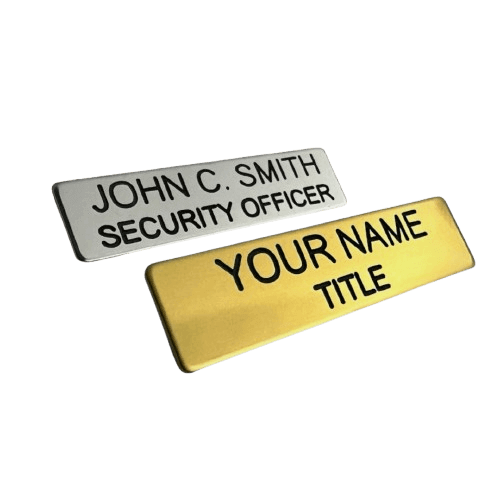
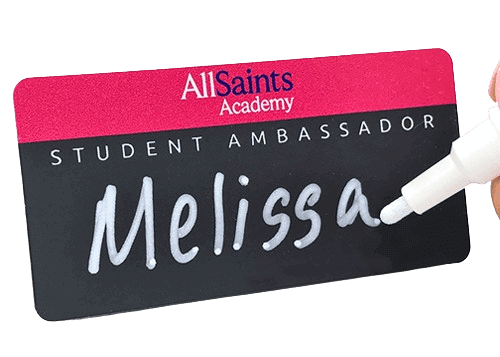
An ID card is credit-card size (CR80) and usually carries a photo, name, title, and sometimes an access chip or barcode. A name badge is a different product and a different shape: the common sizes are 1 x 3 in, 1.5 x 3 in, and 2 x 3 in, meant to be read across a room rather than scanned at a reader. Many workplaces use both: a name badge for recognition and a CR80 ID card for access. See name badge sizes or the size guide for wearable badge dimensions.
Portrait or landscape?
Photo ID cards are most often portrait (taller than wide) so the photo sits above the name, but CR80 cards print either orientation. If your card will be punched for a reel or lanyard, leave a clear margin at the top so the slot does not cut through text or the photo.
How we make ID cards
NameBadge.com prints custom CR80 ID cards on 30 mil PVC, in full color, in both horizontal and vertical designs, with room for a photo, name, title, logo, and a barcode or QR code. Cards are produced in-house in the USA by a family-owned manufacturer operating since 2008, and US orders over $200 ship free. Start a card on the ID card order page, or request a quote for a full photo-ID program.
Frequently asked questions
Is a CR80 card the same size as a credit card?
Yes. A CR80 card is 3.375 x 2.125 inches (85.6 x 54 mm) with 1/8 inch rounded corners, exactly the ISO/IEC 7810 ID-1 size used for credit and debit cards.
What is the difference between CR79 and CR80?
CR79 is slightly smaller, 3.303 x 2.051 inches (83.9 x 52.1 mm), so it can be stuck onto a CR80-size proximity card or clamshell without overhanging the edges. CR80 is the full-size printed card most IDs use.
What thickness should an employee ID card be?
30 mil (0.030 inch, 0.76 mm) is the durable standard. It is rigid enough for daily swiping, tapping, and slot punching without bending. 10 to 20 mil cards are cheaper but bend and are better for short-term passes.
What size badge holder fits a CR80 card?
Any holder sold as "credit card size" or "CR80" fits a 3.375 x 2.125 inch card, in either a vertical or horizontal orientation. Oversized CR100 cards need a larger "government size" holder.
Can ID cards be printed vertically?
Yes. CR80 cards print in either orientation. Vertical (portrait) cards are most common for photo IDs worn on a lanyard; horizontal cards are common for access and membership cards carried in a wallet.
Like our answers?
Make NameBadge your preferred source on Google
One tap puts a preferred badge on our answers in your Google Search & AI results. No account, no sign-up.