























Are Magnetic Name Badges Safe?
Complete pacemaker & medical device safety guide for workplaces.
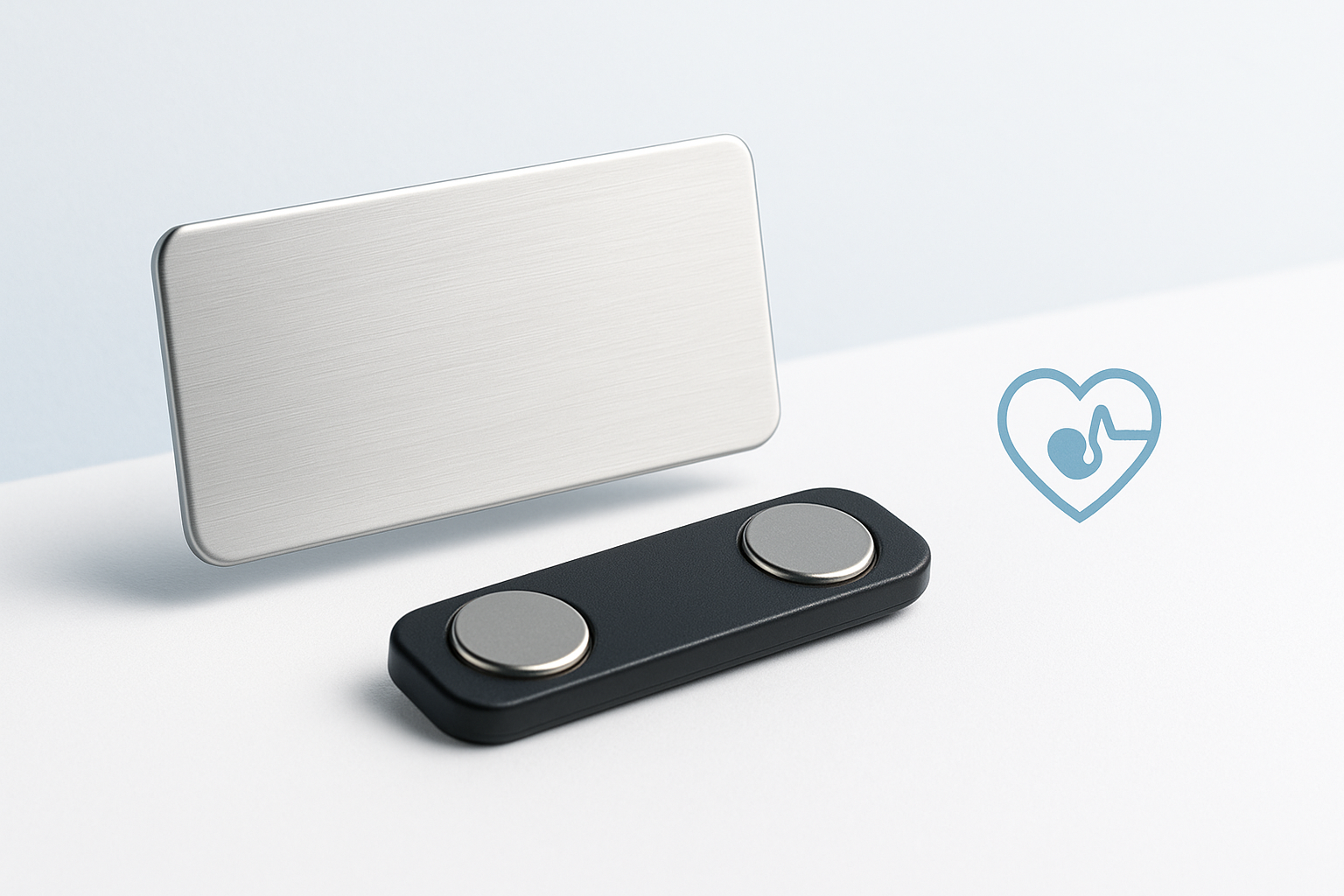
Magnetic name badges are safe for the vast majority of people. However, if you have a pacemaker, ICD, or any other implanted electronic medical device, we do not recommend magnetic fasteners at all — because badges are worn on the chest, directly over these devices. Choose a pin, clip, or lanyard fastener instead, and consult your doctor if unsure.
✓ Safe for Most People
Magnetic name badges use small neodymium magnets that pose no health risk to healthy individuals. They've been used safely by millions of workers worldwide for decades. The only concern is for people with certain implanted medical devices.
Who Should Avoid Magnetic Name Badges?
⚠️ Medical Device Warnings
The following individuals should use alternative fasteners (pin, clip, or lanyard) instead of magnetic badges:
- Pacemaker wearers — Magnets can interfere with pacemaker function
- ICD (Implantable Cardioverter-Defibrillator) users — Can affect device sensing
- Insulin pump users — Some pumps are magnet-sensitive
- Neurostimulator implants — Can affect device operation
- Cochlear implant users — External processors may be affected
If you have any implanted electronic medical device, consult your doctor before using magnetic name badges.
How Magnetic Badges Can Affect Pacemakers
Modern pacemakers and ICDs have a "magnet mode" that can be activated by external magnets. When a magnet is placed near these devices:
- Pacemakers may switch to asynchronous pacing mode
- ICDs may temporarily suspend arrhythmia detection and therapy
- Effects are temporary and reverse when the magnet is removed
- Distance matters — effects only occur when magnets are within 6 inches
🚫 Our Recommendation for Implanted-Device Wearers
While medical guidance often cites a 6-inch (15 cm) minimum distance between magnets and implanted cardiac devices, name badges are worn on the chest — directly over where pacemakers and ICDs are implanted. That is well inside any safe margin.
For this reason we do not recommend magnetic-fastener name badges for anyone with a pacemaker, ICD, or any implanted electronic medical device — at any distance. We recommend a pin, clip, or lanyard fastener instead. When in doubt, choose a non-magnetic fastener.
Medical disclaimer: This page is general information, not medical advice. It is not a substitute for guidance from a qualified healthcare provider or your device manufacturer. If you have a pacemaker, ICD, or any implanted medical device, consult your physician before wearing any magnetic product. NameBadge.com does not assume liability for use of magnetic fasteners by individuals with implanted medical devices; a non-magnetic fastener is always available on request.
Safe Alternatives for Pacemaker Wearers
NameBadge.com offers several pacemaker-safe fastener options:
| Fastener Type | Pacemaker Safe? | Pros | Cons |
|---|---|---|---|
| Pin Fastener | ✓ Yes | Secure, traditional, affordable | Creates small holes in fabric |
| Swivel Clip | ✓ Yes | No fabric damage, easy transfer | Requires pocket or collar |
| Pocket Clip | ✓ Yes | Easy on/off, no damage | Requires shirt pocket |
| Military Clutch | ✓ Yes | Very secure, professional | Creates small holes |
| Lanyard | ✓ Yes | Very visible, ID card compatible | Can be a safety hazard in some settings |
💡 WORKPLACE ACCOMMODATION
If your company uses magnetic name badges, employees with pacemakers should be offered alternative fasteners at no additional cost. This is typically considered a reasonable accommodation under the ADA. NameBadge.com can produce mixed orders with different fastener types for the same badge design.
Are Magnetic Badges Safe for Other Concerns?
✓ Credit Cards & Electronics
Name badge magnets are typically not strong enough to damage modern credit cards, smartphones, or hotel key cards when carried in your pocket.
✓ Pregnancy
Completely safe during pregnancy. The small, localized magnetic field poses no known risk. There is no scientific evidence of any harm.
⚠ Children
While magnetic badges are not toxic, the small magnets could be a choking hazard for young children if the badge breaks apart. Keep name badges away from small children, and supervise older children if they wear badges.
Magnetic Badge Strength Comparison
To put name badge magnets in perspective:
| Magnet Type | Typical Strength | Risk Level |
|---|---|---|
| Name badge magnet | ~50-200 Gauss | Low (6" distance rule) |
| Refrigerator magnet | ~50-100 Gauss | Very low |
| Cell phone speaker | ~100-200 Gauss | Low |
| MRI machine | 15,000-70,000 Gauss | High (contraindicated) |
Best Practices for Workplaces
- Offer alternatives — Provide pin or clip options for employees who request them
- Document policies — Include magnetic badge information in employee handbooks
- Train managers — Ensure supervisors know to accommodate medical device wearers
- Healthcare facilities — Consider mixed fastener policies for patient-facing staff
- No judgment — Never require employees to disclose medical conditions to receive alternatives
🏥 HEALTHCARE SETTINGS
In hospitals and clinics where patients may have pacemakers, staff magnetic badges are generally safe as long as staff maintain normal personal distance. However, some facilities choose pin or clip badges for staff working directly with cardiac patients as an extra precaution.
Read our Healthcare Badge Guide →Related Guides
Order Safe Badge Options
Whether you need magnetic badges for most of your team or alternative fasteners for specific employees, NameBadge.com has you covered:
- ✓ Mixed fastener orders — Same badge design with different attachments
- ✓ All fastener types available — Magnetic, pin, clip, military clutch, lanyard
- ✓ No extra charge for standard fastener swaps
- ✓ Free shipping on all orders
Frequently Asked Questions
Are magnetic name badges safe to wear?
Yes, magnetic name badges are completely safe for the vast majority of people. The only exception is for individuals with pacemakers, ICDs, or other implanted electronic medical devices, who should use alternative fasteners like pins or clips.
Can I wear a magnetic name badge with a pacemaker?
No, it's not recommended. Magnetic name badges should be kept at least 6 inches away from pacemakers. Since badges are worn on the chest where pacemakers are typically implanted, pacemaker wearers should use pin, clip, or lanyard fasteners instead.
Will magnetic badges damage my phone or credit cards?
No, name badge magnets are not strong enough to damage modern smartphones or credit cards. The magnets are designed to securely hold the badge while being safe for everyday use around electronics.
Are magnetic badges safe during pregnancy?
Yes, magnetic name badges are completely safe during pregnancy. The small, localized magnetic field from a name badge fastener poses no known risk to pregnancy. There is no scientific evidence of any harm.
What are the alternatives to magnetic name badges?
Alternatives include pin fasteners, swivel clips, pocket clips, military clutch backs, and lanyards. NameBadge.com offers all these options and can produce orders with mixed fastener types at no extra charge.
How far should magnets be kept from pacemakers?
Medical device manufacturers generally recommend keeping magnets at least 6 inches (15 cm) away from pacemakers and ICDs. This applies to all magnets, including those in name badges, not just strong industrial magnets.
What happens if a magnet gets too close to a pacemaker?
When a magnet is placed near a pacemaker, it can activate the device's "magnet mode," causing it to switch to asynchronous pacing. For ICDs, the magnet may temporarily suspend arrhythmia detection. These effects are temporary and reverse once the magnet is removed.
Are all magnetic name badges the same strength?
No, magnetic strength varies by manufacturer. NameBadge.com uses rare-earth neodymium magnets that are stronger than cheap ferrite magnets (so badges stay put) but still safe for general use. All name badge magnets should be kept away from pacemakers regardless of type.
Can magnetic badges affect insulin pumps?
Some insulin pumps can be affected by magnetic fields, though sensitivity varies by model. Most modern pumps are designed to be resistant to everyday magnetic exposure. If you wear an insulin pump, consult your device documentation or manufacturer. For chest-mounted pumps, consider using a clip or lanyard instead.
Should hospitals use magnetic name badges?
Many hospitals successfully use magnetic badges for staff. Staff badges are typically far enough from patients during normal interactions. Hospitals can offer pin alternatives for employees with pacemakers or those working closely with cardiac patients. NameBadge.com can provide mixed fastener orders.
Need Help Choosing the Right Fastener?
Our team is happy to help you select the best fastener options for your organization, including accommodating employees with medical devices.
800-243-9227
On our website
support@namebadge.com
Customer Reviews
Rated 4.9★ based on thousands of verified reviews across Google, Trustpilot, and ResellerRatings.
Design Your Name Badges Today
Every order is prepared and reviewed by human designers using professional design software before production.